

Monika Grygier is a visual artist whose work navigates abstraction as a realm where silence, time, and inner landscapes emerge. Originally from Poland where she received her formal education in Fine Arts at both the University of Opole and the University of Silesia, she’s currently based in Catalonia. Her visual language is marked by precision and rigor, offering a deeply introspective exploration of the tensions, rhythms, and subtle frictions that define the human experience.

She utilizes controlled layers of acrylic, graphite, and structural components to craft paintings that serve as maps of emotional and perceptual experiences. Her current creations further explore abstraction as a way to chart the unseen yet profoundly experienced, providing viewers with a space for contemplation and connection.
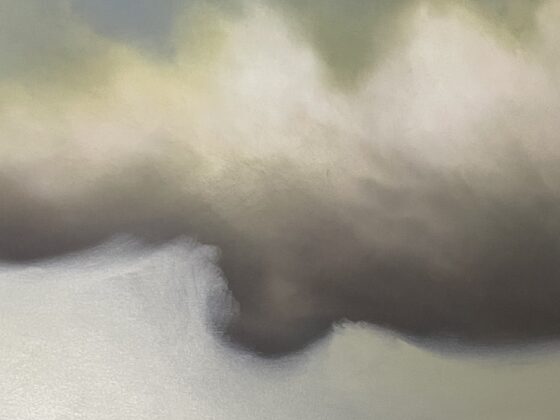
The “Cartografías del Silencio” (2025) series is a project where Monika explores how internal processes—emotional, perceptual, and psychological—can manifest through abstraction. These pieces are created using controlled layers of acrylic, graphite, and sometimes ABS, forming structures, tensions, and areas of friction that serve as maps of invisible territories. Each painting delineates boundaries, directions, and weathered surfaces that allude to spaces of silence, containment, and concentration, conceptualized as analytical zones rather than poetic states. The aim is to translate a complex inner experience into a visual language that is precise, rigorous, and distilled, maintaining continuity with the conceptual framework of this series.

Drawing from her extensive exploration of abstraction, Monika Grygier continues to map the invisible yet deeply felt realms of emotional, perceptive, and psychological processes. Through meticulous layering of acrylic, the artist constructs a visual language that distills complex internal experiences into a rigorous, precise form. The composition unfolds through a harmonious interplay of structures, tensions, and friction areas.
“Cartographies of Silence: 36 Km²” functions as a map of non-visible territories. The boundaries, directions, and eroded surfaces evoke zones of silence, containment, and concentration, not as mere poetic states but as realms for analysis and introspection. This approach aligns with Grygier’s ongoing exploration of the dynamic interplay between urban landscapes and the soul’s timelines.
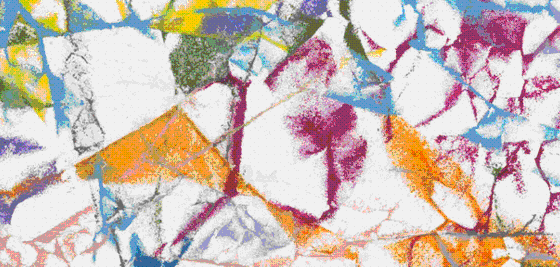
The “Semanas” series explores the interplay between time, structure, and urban experience. As critic Jaume Fàbrega pointed out—recognizing in Monika’s work “urban landscapes and the times of the soul”—these paintings examine the evolving architecture of days and hours, not through direct representation, but via an abstract spatial logic that organizes rhythms, movements, and tensions. The compositions are defined by angles, directions, and floating elements that imply temporal flows, disruptions, and continuities.

In “Sabado mediodía en la ciudad” Monika examines the dynamics of city life on a Saturday afternoon. Through her unique visual language, she maps the kinetic energy of urban spaces, translating the hustle and pause of city rhythms into a layered, complex composition.
The artwork is constructed with controlled layers of acrylic, presenting a juxtaposition of geometric forms and textured surfaces. These elements create a sense of movement and stillness, reflecting the ebb and flow of urban life. The varying shades and subtle contrasts evoke both the vibrancy and tranquility found within cityscapes.

Monika Grygier’s work delves into abstraction to explore the unseen elements that shape our experience, such as silence, time, and inner tension. She meticulously constructs her paintings with layers of acrylic, graphite, and precise structural gestures, resulting in inner landscapes and surfaces that act as emotional maps. Her visual language blends precision with sensitivity, creating contemplative spaces where hidden rhythms, frictions, concentrations, and subtle resonances encourage the viewer to slow down and enter an intimate, peaceful realm.
Her works function as a cartography of emotion and perception, capturing the interactions that define urban existence. They encourage reflection on the unseen nuances that characterize daily life, fostering a deeper connection to the spaces we inhabit.

Monika Grygier
Poland, 1970
Curated by