

Interview with Stefano Recanati
In this interview, we explore the creative process, inspirations, and the projects of Stefano Recanati. Join us for an insightful look into the world of this innovative artist.
Hi Stefano, how does inspiration for a new project emerge and develop during the creative process?
Since I encountered forms, a journey began with them, during which my ideas and fantasies related to these works are in constant motion. It’s difficult to pinpoint specific moments when “the right inspiration” arises: my thoughts are constantly working, and the forms accompany me throughout the day. Special commissions can influence the direction of my reflections, imposing guidelines to follow. The approach also changes depending on the type of work: sculptures depend almost exclusively on continuous thoughts, while for panels and wall works, a long phase of sketches is necessary.
What are the most important stages of your creative process?
The initial part is the most important: long thoughts are followed by sketches and a small model that accompanies the realization of the sculpture. The search for form is obviously the fundamental phase; the final idea often emerges at this first moment, and the work will hardly undergo changes during processing. Thanks to the scale model, it’s immediately clear if everything works.
How do you decide which idea becomes a final piece?
In my work, there is always an unconscious component and a more reasoned one. The choice of the idea— in my case, the form— that will become a work occurs instinctively and with conviction. It’s difficult to explain why: I probably draw upon all the information accumulated over the years about my forms and immediately sense if that specific one must come to life. If I have even the slightest doubt, it’s as if I freeze and postpone the start of the definitive work: the signal is very clear.
How does experimentation influence the final outcome?
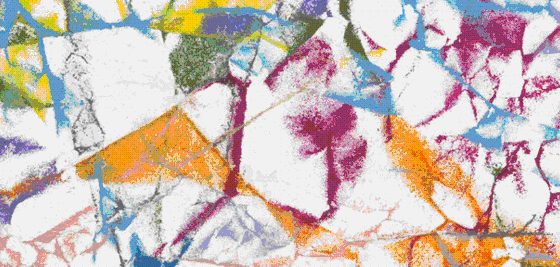
In my research, the final result arises from experimentation. The forms, in fact, originated from a school experiment: many drops of acrylic paint spread with a spatula on a sheet generated sinuous stains from which the artistic journey that led to their creation began. Over time, however, experimentation has become more marginal, and it rarely directly influences the final result today.

“In my research, the final result arises from experimentation.”
How do you handle revisions or modifications during the creation of a piece?
When I start a work, I am always very convinced, probably due to the numerous thoughts and sketches that precede the definitive elaboration. Therefore, it is rare to encounter real snags. During the search for forms, however, I often stop to observe the work from all perspectives, making almost imperceptible changes: it’s one of the most delicate phases. There was, however, a particular case where, during the search for the correct form, I instinctively got blocked; the work was abandoned for a while until I cut a part of it, found what I was looking for, and was able to complete it.
How important are technical preparation and instinct in your process?
They come into play at different stages, but both are fundamental. In the initial research phase, instinct prevails, linked to an emotion, to something unconscious that leads me to quickly sketch many forms. This is followed by a more rational and precise study, searching for balance. Here, technical preparation becomes essential: the materials require specific skills, and instinct gives way to precision. The work comes to life just as it was conceived, without further modifications. Technical shortcomings would lead to errors and, consequently, random results.
How much time do you dedicate to the conceptual phase compared to the material realization?
The conceptual phase is almost always active: forms constantly accompany my thoughts, and everything I read or see intertwines with them. The realization has instead alternating phases: I often engage in manual work, but there are periods when it becomes more intense, especially in creating sculptures. There is a good balance between the two phases, although when I start working intensely on a sculpture, I enter a loop and temporarily set aside the conceptual part: the form about to be born becomes a fixed thought.
How do you work on the composition and visual structure of your works?
It depends on the type of work. Sculptures are born in my thoughts: after years, I know how to navigate this world of fantastic forms and, keeping in mind the works already created, I can achieve pieces that function well in the initial phase. In these cases, sketches are only used to fine-tune, without overhauls. For wall works—canvases, panels, etc.—the process is different: here, there is extensive work with sheets and pencils to achieve a balanced result, both in formal and chromatic research.

How do you determine that a work is truly complete and ready for exhibition or sale?
Knowing my forms very well and working with a process that leaves little room for chance, I already know from the conception of the work if it will work. Of course, accidents can always happen; for this reason, technical mastery of materials is fundamental. The forms come into being just as they are conceived and sketched, leaving no room for errors, and almost always the desired result is achieved.
How does feedback from other artists or critics influence the final outcome?
Feedback is fundamental for me, not only from artists, critics, or professors but also from any viewer. Since the beginning of my journey, I have welcomed every comment, observation, or suggestion regarding my forms. To seek increasingly curious and engaging works, it is essential to show my work to as many people as possible and analyze every reflection, from the simplest to the most complex. All these indications guide me in subsequent forms: considering all the information collected, I strive to create works that deeply engage the viewer.

How much space do you allow for improvisation in your creative process, and how does it reflect on the final outcome?
It depends on the type of work. In sculptures, it is difficult to find improvised elements: the idea is clear, and from start to finish, the form does not change. In wall works, however, improvisation can emerge: in sketches, I often “let my hand go,” allowing space for the immediacy of the gesture and quick movements that give rise to spontaneous, partly improvised forms.
How does experimentation with technique and style help you define the final product?
Technical experimentation was essential at the beginning of my journey: I knew from the outset what my forms needed to look like for the message to come across. Experimentation generated errors and more “fragile” works until I found the most suitable materials. Over time, my technical skills improved, speeding up the process and allowing me to devote more attention to the ideation phase.

Is there a phase of the process that you find more rewarding or challenging?
There are two phases I consider more important than others. The first is the search for the definitive form: I observe the work multiple times, walking around it and making small modifications by carving polystyrene; it is here that the form comes to life. The second is the sanding phase: it is done entirely by hand, which makes it long and laborious, but also extremely rewarding. In this phase, I enter into continuous contact with the form, building a relationship with it. After days of work, all signs of the materials used to cover the piece disappear, and the form distances itself from the earthly dimension, belonging to another reality, ready to be adorned with color.
We extend our heartfelt thanks to Stefano Recanati for this engaging interview.
Curated by


