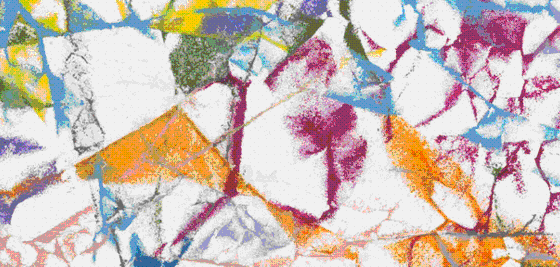


This article analyzes Rafael Timoner’s Alg@rithmus series through an interdisciplinary theoretical framework that integrates posthumanism, materiality studies, algorithmic epistemologies, and critical ecological thought. Through the manipulation of natural algae and industrial materials such as tar, Timoner constructs an aesthetic territory where the organic and the artificial intertwine, generating a reflective space on the hybrid ontologies that characterize contemporary life. The work functions as a conceptual device that problematizes the boundaries between nature and technology, inviting reflection on the distributed agency of living and non-living systems.

In a context marked by the expansion of algorithmic technologies, ecological crisis, and the growing hybridization between organisms and technical systems, contemporary artistic practice has developed new ways of interrogating the relationships between the living and the artificial. Rafael Timoner’s Alg@rithmus series emerges within this scenario, proposing a material and conceptual dialogue between natural algae and structures inspired by algorithmic processes.
The project does not merely represent these tensions; it materializes them. The algae—manipulated and reconfigured—coexist with tar and with compositions that evoke computational patterns. The work thus becomes an aesthetic laboratory in which new ways of thinking about the co-evolution of nature and technology are tested.

The posthumanist framework offers a key lens for understanding Alg@rithmus. Authors such as Donna Haraway and Rosi Braidotti have questioned the centrality of the human subject and proposed ontological models based on interdependence and distributed agency. From this perspective, the algae present in the work are not passive materials but actants within an assemblage that includes the artist, processes of manipulation, industrial materials, and algorithmic logics.
The series embodies what Haraway calls “naturecultures,” hybrid entities that overflow traditional categories. Timoner does not present nature as a pure space nor technology as an autonomous domain; rather, he shows how both are co-constituted on the same plane of reality.
The use of algae situates the work within the field of living materialities, an area widely explored in bioart. However, unlike biotechnological practices that operate in laboratory settings, Timoner develops an expanded bioaesthetics in which the living is approached through its material agency and its capacity to generate patterns.
The algae introduce biological temporalities that intertwine with the temporality of the artistic gesture and the abstract temporality of the algorithm. This coexistence produces what Jens Hauser describes as “process aesthetics,” where the artwork is not a static object but a dynamic field of transformations.

The concept of the algorithm in Alg@rithmus is not limited to its computational dimension. Following authors such as Lev Manovich and Matteo Pasquinelli, it can be understood as a contemporary epistemology that structures perception and the organization of the world.
In Timoner’s work, this logic manifests through:
- repetitive patterns and bifurcations that evoke iterative processes,
- compositions that reference structures of classification and order,
- tensions between the unpredictability of the living and the determinism of calculation.
The series thus functions as a material translation of algorithmic thought, showing how living systems also operate through rules, rhythms, and variations.

The presence of tar introduces an ecological and critical dimension. As a fossil material, it refers to the deep temporality of geology and the anthropogenic imprint on ecosystems. From the perspective of dark materialism (Morton, Parikka), tar embodies the persistence of industrial residues and their integration into contemporary ecologies. The work becomes a material archive of ecological tensions, where the living and the toxic inhabit the same plane.
From the perspective of assemblage theory (Deleuze, Guattari, DeLanda), Alg@rithmus can be understood as an agencement in which biological, chemical, human, and technical forces converge. The work is not an isolated object but a node within a network of relations.

RAFAEL TIMONER
Spain, 1964
Curated by


