
Wolfgang Sandt (born 1960 in Munich) is a German sculptor and author. After attending the Academy of Fine Arts, in Munich between 1979 – 1981, Sandt completed an apprenticeship as a stonemason and stone sculptor, which he completed in 1995 with the master title. Since 1985, he has worked with various sculptors, mainly working in the public space and in the sacred area. Sandt works as a freelance artist and this is his specific working method.

Modern cutting tools, such as a “Flex,” which is a common name among German-speaking sculptors and stonemasons for all types of angle grinders (named after the first “Flex” by Ackermann + Schmitt), are typically used for rough stonework to save time. Afterwards, traditional hand tools are often employed again. The aim is to eliminate the marks left by modern tools and create the impression of traditional craftsmanship.
The Wolfgang Sandt’s approach is different. He tries to exploit the capabilities of the Flex to the fullest. The tool marks should not disappear; on the contrary, they are an essential part of the design. This loud, potentially dangerous, seemingly coarse and brutal tool offers processing possibilities that traditional tools do not, or only to a very limited extent.

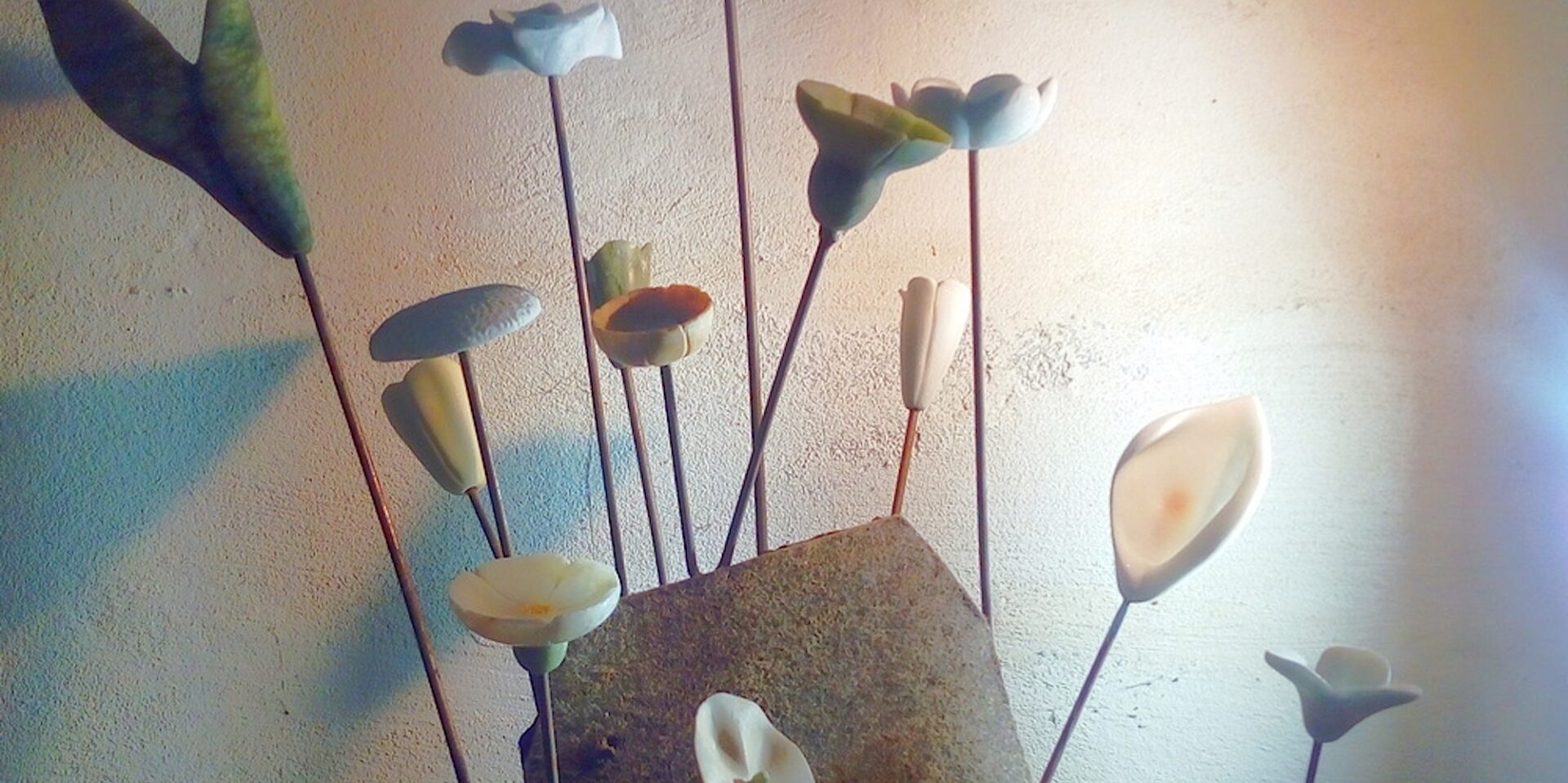
One can work both very roughly, removing large pieces, and also achieve the finest chiseled structures. It is possible to make the stone translucent over large areas, thereby creating an entirely new form of stone sculpture.
In his translucent works, he develops, with the help of a modern tool, a new, contemporary visual language that is completely different from that of traditional stone sculpture. Interestingly, however, this visual language is often perceived by many people not as modern in a factual, mechanical, or cold sense, but rather, on the contrary, as very poetic.
His preferred materials are different types of marble and other stones that can be shaped to become translucent. When he creates his light stones, Wolfgang is inspired by nature. By the sky, clouds, water, fire – things that are fleeting, elusive, and at least to some extent filled with light. The elusiveness and constant change inherent in most of these natural phenomena contrast with our perception of the Earth as something solid and unchangeable. Anyone who has experienced an earthquake or a volcanic eruption or has had to repair settlement cracks in the plaster of their house knows that this perception is deceptive.
The question arises involuntarily: what remains when our perceived certainties begin to wobble?
When something we desperately want to hold onto inevitably slips through our fingers?
What values hold true when a hard material, seemingly made for eternity, like stone, suddenly dissolves into light?
These questions guide the mood and Of course, he also address this question in many of other sculptures, such as the fragile steles or his sculptures of houses in all conceivable unstable or extremely precarious situations.
What remains of the idea of the safety of one’s own four walls, “My home is my castle,” for which the house stands in our thinking?
His boat sculptures are also, of course, inspired by the idea of the mutable, although the boat, in contrast to the house, is inherently a symbol of travel and its associated uncertainties, of newness, of transitions—in short, of change. And so, change ultimately is the only certainty that reliably remains with us. of each piece. Sometimes the reference is so strong it demands a certain approach. Other times, the emotions dictate what happens. Every canvas becomes a negotiation between intention and instinct.

Wolfgang Sandt’s motto is “Contribute to the beauty of the world”.
He applies it to his daily life and thus also to his artistic work.
In his eyes, our world is beautiful, despite all the things that we dislike, that scare us, that are ugly and destructive, that deeply unsettle us, and make us angry. Our world is beautiful in countless ways, in stunning landscapes, in the ever-changing play of light and shadow, in the sound of music, in a flower, or in the smile of a loved one.
Listing the beauty of our world would surpass the scope of any book, any Wikipedia page, any analog or virtual photo album.
The artist feels committed to the preservation and enhancement of this beauty.
This does not mean that he believes his art, or art in general, should only be harmlessly sweet and should not offend anyone. To point out the ugly, destructive things that unfortunately also exist, art can and must deviate from the paths of mere beauty and harmony. Sometimes, it must place its finger in the painful wound to allow for healing.
Ultimately, this healing is the task assigned to all of us, at least to those who have the means and abilities in some way to do something about it.

From the artist’s perspective, creating beauty is part of this healing, part of our ability to make the world a better place. Throughout all epochs, artists have tried in their own, often very different ways to contribute to the beauty of the world.
Wolfgang Sandt’s art is intended, as best as he can, to be part of this tradition of beauty and perhaps a contribution to making our world more beautiful and better.

Wolfgang Sandt
Germany, 1960
Curated by